The 4D battery is commonly used in heavy-duty cars, boats, Alma vehicles, and factory tools, as well as in the industrial environment. It is, however, bulky, heavy, and costly, thus making people wonder whether it is possible to replace one 4D battery with two smaller batteries. Smaller batteries have the advantage of being easier to handle, possibly lowering individually and can in some cases be physically connected to obtain the same capacity. It is necessary to learn about the working process of battery banks, their advantages, and the disadvantages of such a system before such a swap is made.
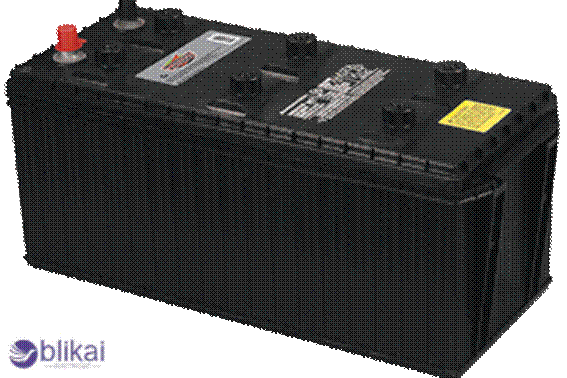
Understanding the Size and Capacity of a 4D Battery
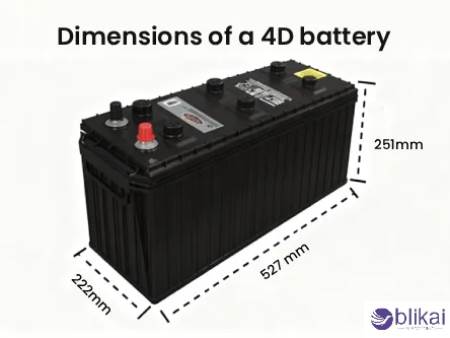
A conventional 4D battery is a high amp-hour-rated 12-volt battery most frequently found between 150 and 200Ah. This renders it into an outstanding source of power that can withstand commencing and deep-cycle applications based on design. When using two smaller batteries, the total voltage and capacity must be that of the original 4D. As an example, 100Ah 12-volt batteries connected in a parallel combination will give 200Ah at 12 volts, approximately equivalent to a large 4D.
The Role of Series vs. Parallel Connections
With a number of smaller batteries, the wiring arrangement is important. A series connection will raise the voltage, but leave the amp-hour capacity unchanged, whereas a parallel connection will leave the voltage unchanged but increase the amp-hour capacity by a factor of two. Most applications involving the replacement of a 4D will utilize the parallel connection because the equipment is originally designed to run with 12 volts. As an example, two batteries, each 12 volts, and a capacity of 100Ah ( parallel ) = one battery 12 volts and a capacity of 200Ah.
Potential Advantages of Using Two Smaller Batteries
Smaller batteries are less cumbersome to lift, install, and change than to change a single heavy 4D that may weigh more than 100 pounds. Second, should one of the batteries fail, it does not leave you with nothing to spare, whereas a 4D would provide no backup. Smaller batteries are another source, and since they are easier to obtain may be cheaper on a per-unit basis. These are the practical benefits, which make the concept worthwhile to contemplation, especially by individuals who care about convenience and flexibility.
Challenges and Downsides to This Approach
Even though it comes with advantages, the fact that a 4D is replaced by two smaller batteries is not always desirable. Space is a large con: two smaller batteries can be larger than one 4D, at least according to your layout. Wiring connections further add mess and the chance of uneven charging or discharging when the two units are joined. Over the long term, imbalances can reduce the life of the battery. These problems explain why there are certain users who feel content in using only one dedicated 4D.
Charging Considerations for Multiple Batteries
Ideally, both batteries are preferably of the same brand, type, age, and capacity to ensure even charging. When one does not fit with the other, one of the batteries will be charging more than the other, stressing the system. A multi-bank smart charger is the most ideal since it targets every battery to be charged and still functions as one charger. Use the wrong charger and you risk decreased efficiency, accelerated wear and long-term problems in reduced performance that not only cancel out all the low benefits of using small batteries, but create secondary effects that may rise well above their low original benefits.
Cost Comparison: One 4D vs. Two Smaller Batteries
Looking on the surface, two smaller batteries appear to be cheaper compared to a single 4D battery. Nevertheless, the comparison of costs is not so reliable. Two group 27 or group 31 batteries may be cheaper alone, but you may have to purchase cables, connectors and even a dual-bank charger, so the overall cost is higher. And, should the smaller batteries become exhausted sooner as a result of being unbalanced or improperly charged, you may end up spending more in the long run. Direct price comparison must hence be done by incorporating upfront prices as well as long-term maintenance details.
Application-Specific Decisions: RV, Marine, and Industrial Use
The decision to use two smaller batteries or one 4D battery depends heavily on your application. For RV users who want easier handling and redundancy, two smaller batteries might be a good choice. Marine users, however, often prefer a single 4D for simplicity, as boats can be sensitive to wiring issues and space constraints. Industrial equipment may require the raw capacity and durability of a single heavy-duty 4D.
Common Mistakes to Avoid When Substituting Batteries
When you choose to use two smaller batteries, do not make mistakes that result in handedness, and shorten battery life or become dangerous. Usage of different brands, ages, or capacity mixing is one of the biggest mistakes and making it unbalanced and leading to wear quickly. Another error is undersized cables that can overheat or even result in a voltage drop when the cable is loaded. Others ignore the need for ventilation, especially the flooded batteries. Lastly, regular monitoring and equalizing of the batteries is necessary since this can decrease system performance tremendously.
Conclusion
So, can you replace one 4D battery with two smaller batteries? The answer is yes—but with conditions. It can be a practical solution if done correctly, especially when convenience, availability, and redundancy are priorities. However, it does introduce added complexity in installation, charging, and maintenance. For users who value simplicity and reliability, sticking with a single 4D battery may still be the smarter move.